To truly safeguard a rare breed like the Entlebucher Sennenhund, preservation breeders must look at two completely distinct data layers: Census Population Growth (where the dogs live physically) versus Effective Population Size (Ne) (how their genetic material flows across generations).
When these two data points are compared, they expose a quiet crisis: our breed does not have a population shortage, but it is facing a critical breeding participation bottleneck.
📊 Cumulative Global Migration (1910–2026)
Data Completeness Note & Disclaimer (Revised October 2026): The population data points for the final 2026 calendar block on this chart are strictly partial-year metrics, capturing historical records, registrations, and international submissions logged from January 1, 2026, through October 2026. Because the current calendar year has not yet concluded, these final metrics do not represent a completed annual pool. They will be updated to reflect final, absolute year-end tallies upon the close of the 2026 registration cycle. The steep visible drops at the absolute edge of the graphs are partially a reflection of this incomplete calendar window and should be evaluated as real-time tracking data rather than a finalized annual trend.
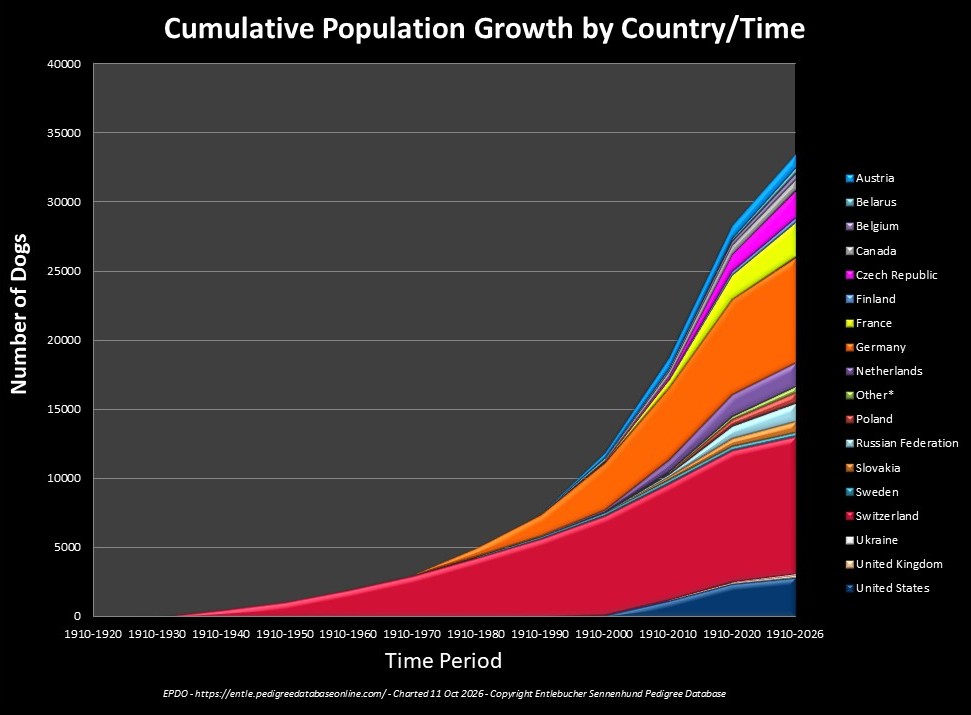
This stacked area chart tracks the incredible growth and migration of the Entlebucher across twenty distinct nations over the last century. For the first seventy years of our history, the breed remained a highly localized Swiss treasure.
Following the archival expansion eras of the late 20th century, international collaboration unlocked massive growth waves across Germany, France, the Netherlands, the United States and eventually, the Czech Republic —scaling our global historical count past 33,000 dogs.
🧬 The Real-Time Genetic Bottleneck (1916–2026)
Data Completeness Note & Disclaimer (Revised October 2026): The population data points for the final 2026 calendar block on this chart are strictly partial-year metrics, capturing historical records, registrations, and international submissions logged from January 1, 2026, through October 2026. Because the current calendar year has not yet concluded, these final metrics do not represent a completed annual pool. They will be updated to reflect final, absolute year-end tallies upon the close of the 2026 registration cycle. The steep visible drops at the absolute edge of the graphs are partially a reflection of this incomplete calendar window and should be evaluated as real-time tracking data rather than a finalized annual trend.
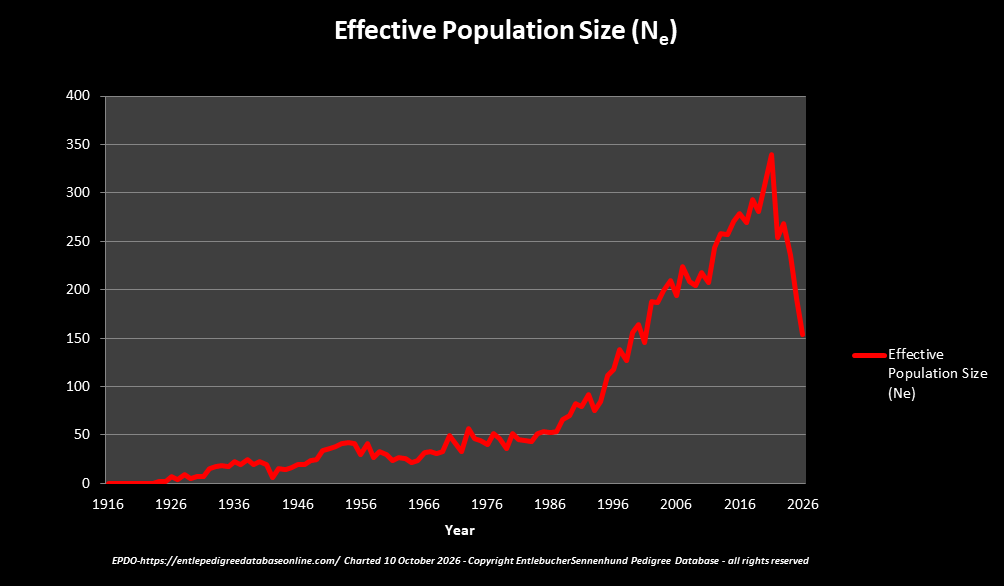
While census numbers look stronger than ever, our live Effective Population Size (Ne) timeline tells a completely different story beneath the surface. Utilizing strict scientific filtration across more than 33,600 verified records, this metric calculates the actual size of our active genetic pool.
- The Collaboration Peak (1986–2019): As our independent international database network grew, breeders successfully shared underutilized lines across regional borders. This pushed our effective breeding pool to a historic, healthy peak near 340 dogs.
- The Modern Cliff (2019–2026): In the last seven years, our Ne has hit a steep, alarming cliff—plummeting from 340 back down to 150 dogs. Because of breeding inaction, our global breed pool is operating as if it has shrunk back to its 1996 footprint.
🛠️ The Preservator’s Call to Action
When we leave healthy, stable dogs unbred because they aren’t “perfect champions,” their unique branch of the family tree is permanently lost to the breed.
We must move past perfectionism and embrace active stewardship. Use the cross-border matchmaking tools within the independent Entlebucher Pedigree Database Online (EPDO) to find compatible partners, minimize the popular sire bottleneck, and help reverse this cliff together.