To truly safeguard a rare breed like the Entlebucher Sennenhund, preservation breeders must look at two completely distinct data layers: Census Population Growth (where the dogs live physically) and Effective Population Size (Ne), (how their genetic material flows across generations). When these two data points are compared, they expose a quiet crisis: our breed does not have a population shortage, but it is facing a critical breeding participation bottleneck.
📊 Cumulative Global Migration (1925–2026)
This stacked area chart tracks the incredible growth and migration of the Entlebucher across twenty distinct nations over the last century. For the first seventy years of our history, the breed remained a highly localized Swiss treasure.
Following the archival expansion eras of the late 20th century, international collaboration unlocked massive growth waves across the world —scaling our global historical count past 33,000 dogs.
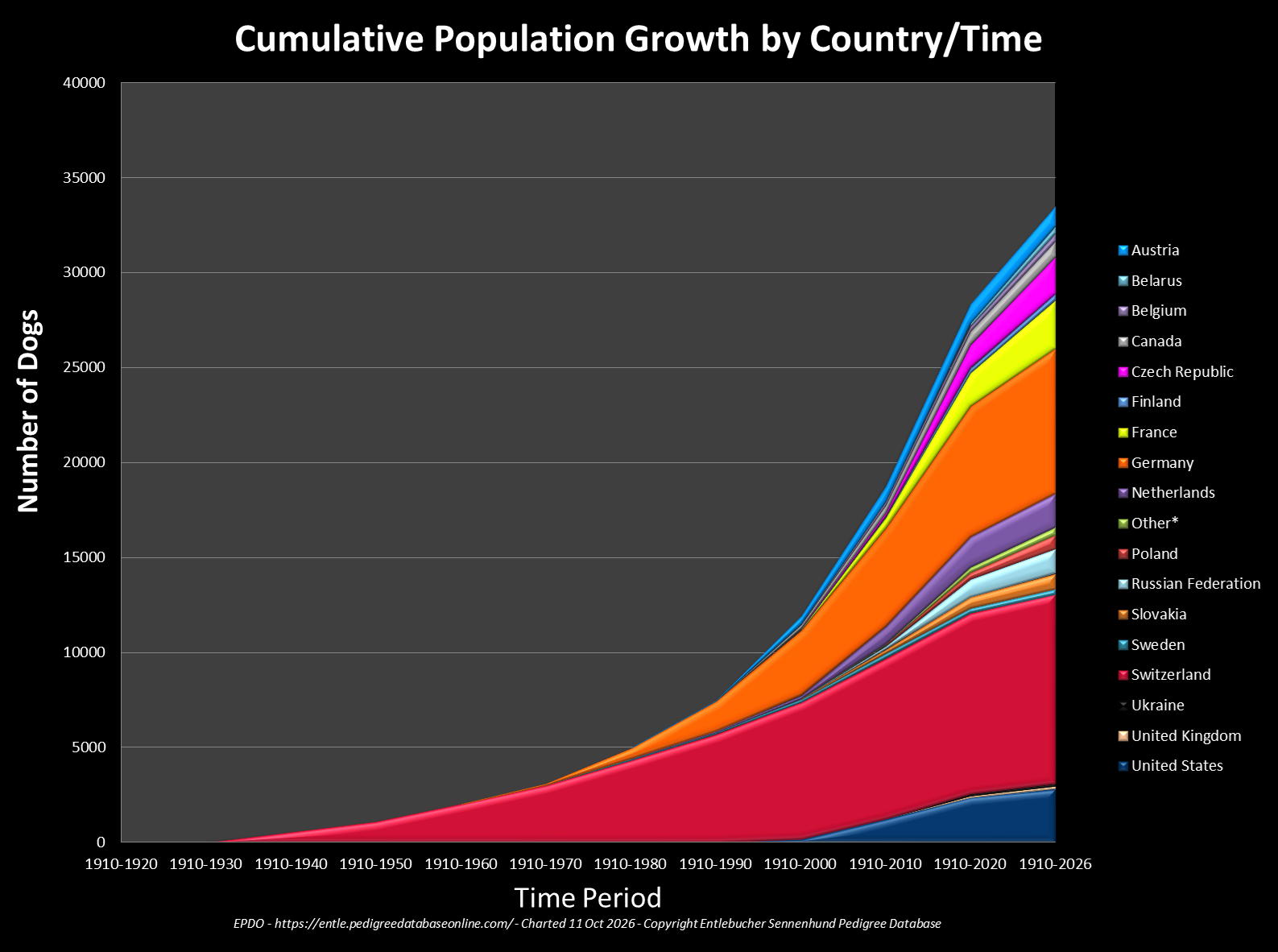
📋 2026 Data Tracking Note: The final 2026 milestone on this area chart is a partial-year metric reflecting international registrations logged through October 2026. This tally will be updated to a complete annual pool upon the close of the 2026 registration cycle.
🧬 The Real-Time Genetic Bottleneck (1916–2026)
While census numbers look stronger than ever, our live Effective Population Size (Ne) timeline tells a completely different story beneath the surface.
Where:
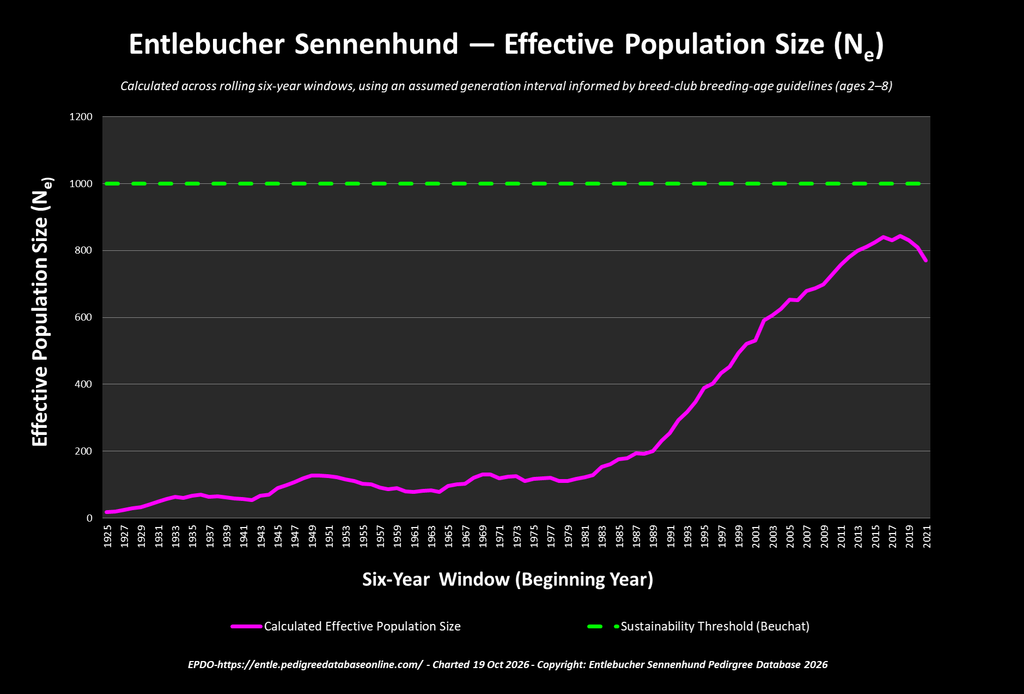
📋 6-Year Window Data Note: Because our generation intervals rely on complete annual blocks, the final 2021–2026 window is a real-time tracking metric utilizing data through October 2026. The downward turn at the absolute edge reflects this incomplete final window.
- The Spreading Footprint (1986–2012) During this foundational era, the Entlebucher expanded around the world more through individual timing and chance than a central plan. Instead of an organized global rollout, the breed’s growth depended on isolated circles of early fanciers who independently brought the first dogs to new countries.
As these scattered pockets of owners grew, local breeding networks gradually began to take shape. This decentralized growth slowly built a steady baseline of regional breeders, eventually setting the stage for the international tracking systems and cross-border cooperation we use today. - The Participation Wave (2013–2020) This era saw a major shift as everyday enthusiasts stepped up to become the primary drivers of the breed’s growth. Instead of relying solely on a few established kennels, a passionate new generation of owners decided to take the plunge and breed a litter.
This widespread participation pushed the breed’s effective breeding population to an all-time high of about 843 dogs. By having so many independent hobby breeders chip in, the community successfully introduced a wider variety of unique sires and dams, giving the global gene pool a vital boost in diversity. - The Modern Squeeze (2020–2026): The edge of our timeline shows a sudden, sharp downturn for the breed. After climbing steadily for decades, our effective breeding pool reached its historic peak of 843 dogs during the 2015–2020 window—a high point made possible by great database tracking and cross-border collaboration. But right after that peak, the floor dropped.
In our final block running from 2021 through October of 2026, our effective population size plummeted to 769, falling even further below the recommended sustainable target of 1,000 dogs. This drop reflects a clear shift in human lifestyles over the last five years: people are busier, and fewer owners are willing or able to take on the massive responsibility of raising a litter. Because of this widespread inaction, our active genetic footprint has quickly shrunk back to where it was a decade ago.
🛠️ The Preservator’s Call to Action: Taking the Plunge
It is undeniable that modern life is incredibly demanding. In a fast-paced world where many of us are busier than ever, it can feel overwhelming to think about adding any more responsibilities to our full schedules.
But it is vital to recognize a comforting truth: whelping a single litter is a focused, rewarding 8 to 10 week adventure.
To reverse our current genetic cliff, we need passionate, hobbyist owners willing to take that plunge just once. When a stable, healthy dog is left unbred because of modern busy schedules or striving for an elusive “perfect champion,” an entire unique branch of our breed’s century-old family tree is permanently erased from the earth.
Contributing just one litter, is actively safeguarding the global heritage, vitality, and very future of the Entlebucher Sennenhund.
🛠️ Turning the Tide: A 3-Pronged Approach
We cannot reverse this genetic cliff alone. It requires a complete shift in how our entire community operates:
- Breed Clubs must become guides, not gatekeepers. 🤝 Leaders need to transition away from heavy restriction and focus on actively encouraging hobbyists to step up. Protecting a breed means mentoring new people, not blocking them out.
- Breeders must prioritize future preservation. 🏡 When placing high-quality puppies, priority should go to homes that are open to carefully breeding a litter down the road. Every stable dog left unbred permanently closes a branch of our family tree.
- Owners must be supported, not left stranded. 🧭 Everyday owners who want to help shouldn’t have to guess. By using the independent Entlebucher Pedigree Database Online (EPDO), we can directly help families research, map coefficients, and find the perfect matches across regional borders.