🧬 Preserving the Entlebucher Heritage: The Depth Behind the Data 🐾
When Dr. Jerold Bell of Cummings School of Veterinary Medicine delivered his 2019 presentation on Entlebucher genetics, his message highlighted an essential truth: understanding a breed’s genetic diversity requires looking beyond shallow pedigrees to see the population as a whole.
But behind that presentation is a story that few people in the audience may have known.
Since 2006, I have worked independently at my desktop, painstakingly transcribing thousands of historical paper records, line by line, to build a comprehensive archive of Entlebucher ancestry.
In 2019, the AKC registry contained approximately 2,400 Entlebuchers, as Dr. Bell noted in his presentation. My independently compiled database already contained more than 19,000 dogs. This achievement was made possible in part by dedicated international partners in Switzerland 🇨🇭, the United Kingdom 🇬🇧, and the Netherlands 🇳🇱, who helped secure vital historical registry archives. I supplied my independent database of over 19,000 dogs to Dr. Jerold Bell to make possible his presentation on Entlebucher genetics at the USA club’s National Specialty, providing a crucially important broader view of our breed’s global ancestry.
The database I supplied to Dr. Bell before his presentation has continued to grow. Today it contains more than 33,600 dogs. Using that expanded database, I calculated the mean inbreeding coefficients across five, ten, and twenty generations and created the chart below.
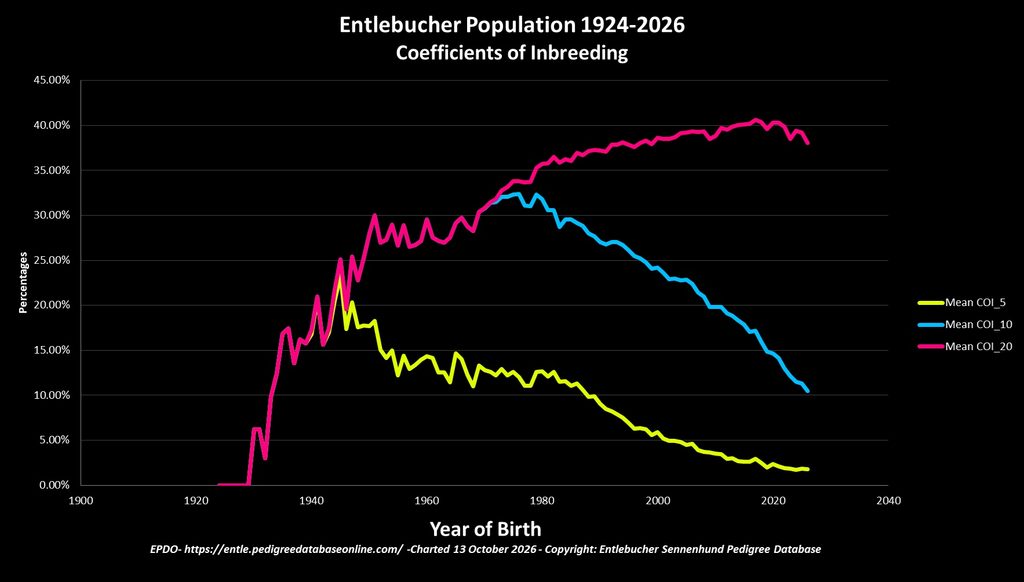
Data Completeness Note & Disclaimer (Revised October 2026): The population data points for the final 2026 calendar block on this chart are strictly partial-year metrics, capturing historical records, registrations, and international submissions logged from January 1, 2026, through October 2026. Because the current calendar year has not yet concluded, these final metrics do not represent a completed annual pool. They will be updated to reflect final, absolute year-end tallies upon the close of the 2026 registration cycle. The steep visible drops at the absolute edge of the graphs are partially a reflection of this incomplete calendar window and should be evaluated as real-time tracking data rather than a finalized annual trend.
And the difference that pedigree depth makes is striking.
📊 What the Data Reveals
💛 The Hidden Picture in Short Pedigrees (Mean COI₅)
A standard five-generation pedigree can give the impression of relatively little inbreeding…
🩵 Looking Deeper (Mean COI₁₀)
Extending the analysis to ten generations reveals substantially more shared ancestry…
🩷 The Deep Ancestry Picture (Mean COI₂₀)
Looking across twenty generations reveals just how much historical inbreeding can remain invisible…
These are mean inbreeding coefficients calculated from only the complete recorded pedigrees in my analysis. They illustrate why pedigree depth matters: the picture changes dramatically when we look beyond five generations.
Behind every line on this graph is a mountain of meticulous human effort: historical records recovered, pedigrees transcribed, identities reconciled, and generations connected across borders.
Today, my independent database tracks more than 33,600 dogs, and I am confident it encompasses the vast majority of registered Entlebuchers worldwide.
This is more than a collection of pedigrees. It is a growing record of our breed’s shared heritage—and a resource for those working to understand and preserve its future.
My heartfelt thanks to the international partners who helped make this work possible, and to the preservation breeders who recognize the value of deep pedigree information in making informed decisions for generations to come.